




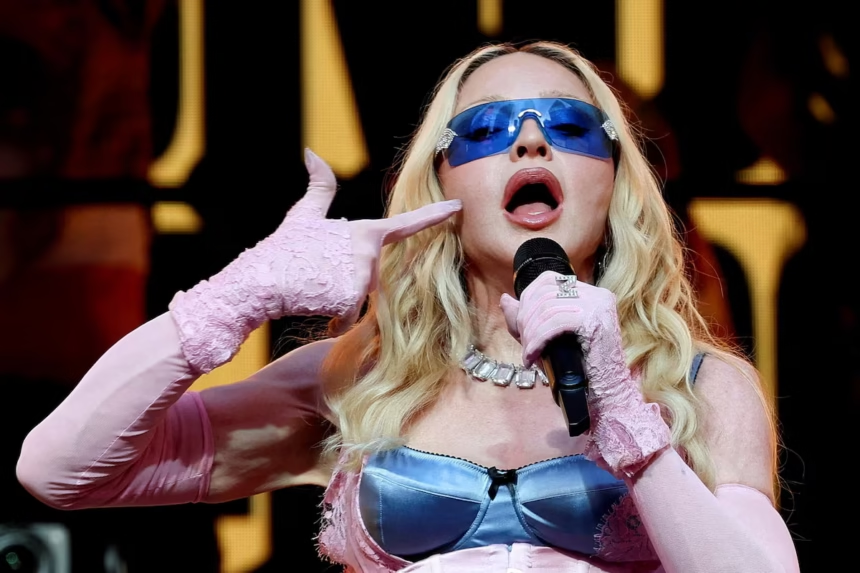
Twenty-one years is a long time to wait for a sequel. Madonna made her fans wait every single one of them.
On July 3, 2026, the 67-year-old icon dropped Confessions II, her 15th studio album and the long-promised follow-up to 2005’s Confessions on a Dance Floor. Within 24 hours, the numbers told their own story: 13,068,922 Spotify streams on release day alone, the biggest single-day debut ever posted by a solo female artist who broke through in the 1980s. By July 6, the album had already claimed the top spot on the UK Midweek Albums Chart, moving 37,106 chart-equivalent units in less than a week.
Streaming numbers are one thing. Critical consensus is another — and this time, Madonna has both.
A 21-Year Reunion, and an 83 on Metacritic
Confessions II reunites Madonna with producer Stuart Price, the architect behind the original Confessions on a Dance Floor and the man largely credited with helping her win the two most recent Grammys of her career, including Best Dance/Electronic Album back in 2007. The new record — 16 tracks, mixed continuously like a single unbroken DJ set, clocking in at just under 64 minutes — pulls from house, disco, downtempo and EDM, with additional production from Martin Garrix, Cirkut, Andrew Watt, Mirwais Ahmadzaï, Arca and the duo Parisi.
The reviews have been the strongest of Madonna’s career since the original Confessions. On Metacritic, the album currently sits at 83 out of 100, built from 15 critic scores — the second-highest rating among her ten post-2000 releases, trailing only the 2009 compilation Celebration. AnyDecentMusic adds a separate 7.5 out of 10 across 12 reviews.
Rolling Stone praised the record’s relentless pacing, calling it “a nonstop groove that flows like a perfect club DJ set.” The Guardian’s Alexis Petridis went further, writing that it’s “unequivocally Madonna’s best album” since the 2005 original. Over at the BBC, critic Mark Savage described the project as “an intoxicating blur of hedonism and exuberance,” while Billboard’s Kate Bain called the finished product a modern take on club music that manages to evoke its history without copying it. The Telegraph’s Neil McCormick summed things up in a single verdict: Madonna reclaims her crown.
That’s a rare run of five-for-five raves for an artist 44 years into her recording career.
Grief, Family and a Daughter’s First Duet
Beneath the four-on-the-floor kicks, Confessions II is arguably Madonna’s most personal album since 1998’s Ray of Light. The record was born out of loss: her brother Christopher Ciccone and her stepmother Joan Ciccone both died in 2024, and Madonna has said she began writing songs about family trauma almost immediately afterward. “Fragile,” track 12, is a direct tribute to Christopher, written in the aftermath of a phone call she later called cathartic. “Betrayal” wrestles with her complicated relationship with her stepmother. “L.E.S. Girl,” the closing track, looks back on her broke, pre-fame years living on Manhattan’s Lower East Side.
The album’s emotional centerpiece, though, is “The Test,” a duet with her eldest daughter, 29-year-old Lola Leon — the same daughter who inspired Ray of Light almost three decades ago and was just nine years old when the original Confessions came out. It marks their first musical collaboration.
Confessions II also spawned a companion film, also titled Confessions II, built around the album’s first six tracks. Directed by TORSO, it premiered June 5, 2026, at the Beacon Theatre in New York during the Tribeca Festival, followed by a conversation between Madonna and Anderson Cooper, before hitting YouTube on June 8.
Why the Grammys Are Suddenly Paying Attention
Here’s where the numbers get interesting for Madonna’s awards case. She has won seven Grammys across her career — a solid total, but a modest one relative to four decades of cultural dominance. She wasn’t nominated for Best New Artist in either 1984 or 1985. Her first nomination in one of the “Big Four” categories didn’t come until 1999, when Ray of Light was up for Album of the Year. She hasn’t landed an Album of the Year nod since that same year, and her last win in an album category dates back to 2007. Her most recent nomination of any kind was in 2010 — a 16-year gap now on the line.
Confessions II could close that gap in dramatic fashion. Warner Records is reportedly planning to submit the album for Best Dance/Electronic Album at the 69th Annual Grammy Awards, set for February 7, 2027, along with “I Feel So Free” for Best Dance/Electronic Recording and either “Danceteria” or “Bring Your Love” (featuring Sabrina Carpenter) for Best Dance Pop Recording. A win in the album category would make Madonna the first woman to win it twice since its introduction in 2005, and it would hand her the longest gap between wins in that category’s history — 20 years — surpassing the 14-year span currently held by The Chemical Brothers.
If she sweeps all three dance categories, it would mark only the second time in her career she has taken home three Grammys in a single night, following 1999. It would also push her career total into double digits for the first time. And the timing lines up with a broader shift at the Grammys: after largely sidelining dance music from its top categories, the Recording Academy has nominated a dance album for Album of the Year twice in the past three ceremonies — Beyoncé’s Renaissance in 2023 and Charli xcx’s Brat in 2024. Only one dance record has ever won the top prize outright: Daft Punk’s Random Access Memories in 2014.
Gold Derby currently has Confessions II ranked 17th in its general Album of the Year field — not yet inside nomination range, but close enough to watch. Should Madonna land Best Dance/Electronic Album, it would be the fourth time in five years a woman has won that specific category.
For an artist who spent much of the past decade watching the Recording Academy look past her, that’s not a small shift. It’s a full-circle moment, 21 years and 83 Metacritic points in the making.