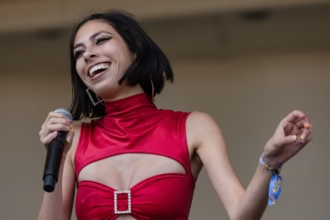


By the time the sun dropped low enough over Irvine’s Great Park to stop punishing everyone standing in front of the Dandelion Stage, it was clear the heat had become part of the story. Rachel Chinouriri joked about it during her early set. Chappell Roan built a joke about it into her introduction for “HOT TO GO!” later that night. Kathleen Hanna, Mitski and Doechii all used their microphones at some point to remind twenty thousand sweating strangers to drink water. Nobody complained about it for long, because nobody at Daisy Chain Fields, Olivia Rodrigo‘s first music festival, seemed interested in complaining about anything they couldn’t fix together.
That, in a sentence, was the entire point of the day.
A Two-Month Promise, Kept
Rodrigo announced Daisy Chain Fields only two months before it happened, unveiling both the festival and its companion charitable fund on Instagram with the kind of unfiltered excitement that read more like a fan post than a press release. She had wanted to build something like this for years, she wrote, and now it was actually real.
On Saturday, August 29, it became more than real. It became proof of concept. Every artist on the all-female bill was there, in Rodrigo’s own words, because she considered them a hero or a friend, and every dollar of net proceeds from ticket sales was earmarked for ten nonprofits working on behalf of women and girls: Baby2Baby, Black Mamas Matter Alliance, the Center for Reproductive Rights, FreeFrom, Jhpiego, the Johns Hopkins Center for Indigenous Health, the National Domestic Workers Alliance, the National Institute for Reproductive Health, the National Women’s Law Center and Planned Parenthood.
The numbers arrived a day early. At a press conference the Friday before the festival, Rodrigo revealed that ticket sales alone had already generated $10 million for those ten partner organizations. She also traced the festival’s roots back to a phone call, telling reporters that Lilith Fair founder Sarah McLachlan was one of the first people she reached out to while the idea was still taking shape. McLachlan would end up on stage with her that same night, alongside two more of the genre’s foundational names.
Thirteen Moments Worth Remembering
The crowd wore the mission. Feminist slogans replaced the usual festival merch clichés, with shirts and tote bags carrying phrases celebrating women’s strength and solidarity. Pin-back buttons matching the festival’s official branding turned into their own currency, with fans swapping them across the grounds the way older festivalgoers once traded friendship bracelets.
Eli opened with a manifesto. The Y2K-styled pop newcomer kicked off the day on the main stage with breakout songs “Girl of Your Dreams” and “F–k the DJ,” then paused to read from her own phone. She explained, plainly and without theatrics, why she planned to donate part of her record advance toward closing the wealth gap.
Rachel Chinouriri debuted new music. On the Marigold Stage, Chinouriri previewed “AAAHHH,” a track from her upcoming sophomore album, “I think I spoke too soon,” due October 16. She told the crowd it was about her twenties and the process of discovering who she still gets to become.
KATSEYE showed up anyway. After a member injury forced the group to withdraw from performing days earlier, three of its members briefly appeared on stage to express support for Rodrigo and the mission before handing things off to their last-minute replacement, Devon Again.
Devon Again turned a scramble into a highlight. Booked with almost no notice after KATSEYE’s withdrawal, the alt-pop artist thanked the crowd repeatedly and later shared, with a laugh, how casually she’d said yes when Rodrigo called two days earlier.
Santigold played a career-spanning set. Pulling heavily from her 2008 self-titled debut and 2012 follow-up “Master of My Make-Believe,” Santigold delivered a set that clearly moved her as much as it moved the crowd, and she said as much between songs.
Bikini Kill preached and taught. Frontwoman Kathleen Hanna used part of her set to speak candidly about the country’s political climate before turning reflective about the privilege of performing at all. She closed with direct advice for younger fans, urging them to keep pushing older generations forward and to hold the men in their lives accountable.
Mitski asked to make it annual. After laying out a few gentle safety reminders for the crowd, Mitski delivered one of the day’s quieter, more meditative sets. She admitted she’d said yes almost instantly when Rodrigo called to ask personally, and by the middle of her set she was already hoping the whole thing would return next year.
Doechii spent her own money on the show. Bringing elaborate staging, sharp choreography and full-body pink paint, Doechii built a headliner-caliber performance despite technically being a support act, reworking hits like “Anxiety” into a rock-inflected arrangement built for a festival crowd.
Garbage turned a mistake into a lesson. After a technical hiccup forced the band to restart a song, frontwoman Shirley Manson used the moment to tell younger fans in the crowd that failing publicly is survivable, and that being unapologetically yourself is the only way to find your people.
Chappell Roan built her set around the theme. Opening with “Super Graphic Ultra Modern Girl” and “Femininomenon” before a flame-backed “HOT TO GO!,” Roan leaned fully into the day’s spirit, closing her set by thanking Rodrigo for the friendship and the platform.
Rodrigo made her own introduction. True to the festival’s efficient, all-day rhythm, Rodrigo herself walked out to introduce her headlining set, first bringing philanthropist Melinda French Gates on stage to reveal that Gates had personally matched the festival’s $10 million in donations, doubling the total to $20 million.
The headlining set closed the loop. Rodrigo mixed catalog staples like “Drivers License” and “Deja Vu” with the recently released “Serena Joy,” then welcomed Sarah McLachlan for a duet before Alanis Morissette filled in for a previously announced guest. As a nearly full moon rose over the stage, Stevie Nicks joined Rodrigo for the night’s final encore, later telling the crowd how proud she was watching Rodrigo pull off something this ambitious with so much grace.
What the Day Actually Proved
Strip away the heat, the pink body paint and the flame cannons, and what’s left is a festival that did exactly what it said it would. It raised real money for organizations doing unglamorous, essential work. It gave a rising artist a stage after a lineup shake-up rather than quietly working around her. It let the genre’s elder stateswomen, McLachlan, Morissette and Nicks among them, share a stage with an artist young enough to have grown up on their records.
Rodrigo closed the night with a simple promise to bring Daisy Chain Fields back next year. Judging by how quickly $10 million became $20 million, and how many artists treated an unpaid guest spot like the biggest booking of their year, she will not be short on people willing to help her keep that promise.