




From Pink’s first-ever Broadway hosting gig to a 53-year-old record shattered by an 80-year-old actor, Broadway’s biggest night delivered exactly the kind of chaos and grace the Great White Way was built for.
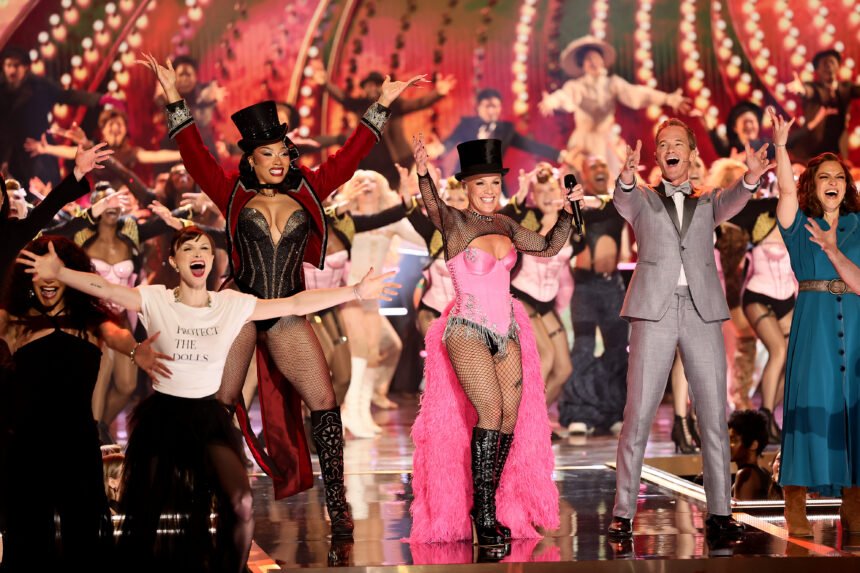
Before anyone handed out a single award Sunday night at Radio City Music Hall, Pink walked out to a packed house of Broadway royalty and did what she does best: cut straight through the pretense. “For some reason, I’m your host,” she told the audience, deadpan. It got a laugh. But it was also kind of the point — nobody expected the pop singer to be standing there, and that energy, the slightly unpredictable, slightly irreverent kind, turned out to be exactly what the 79th Annual Tony Awards needed.
John Lithgow was waiting.
At 80 years old, Lithgow claimed the trophy for Best Actor in a Leading Role in a Play for his turn as the controversial children’s author Roald Dahl in Giant. In doing so, he became the oldest male actor in Tony history to win an acting award and set a personal record that stretches back 53 years to his first Tony win. In a room full of people who live for dramatic moments, this was the real one.
The bigger story of the night, though, belonged to Arthur Miller.
Death of a Salesman — a fierce, reimagined staging of Miller’s essential American tragedy — led the evening with six wins in total. Director Joe Mantello took home the prize for Best Direction of a Play, while Laurie Metcalf earned Featured Actress in a Play, and the production swept the technical categories for scenic, lighting, and sound design. Nathan Lane, nominated for the lead role of Willy Loman, went home without a statue — one of the night’s more pointed surprises, given the critical heat the production had generated all season.
The musical race was messier, and more satisfying for it.
Schmigadoon!, the fizzy Golden Age musical comedy that earned 12 nominations — tied with The Lost Boys as the night’s most-nominated shows — walked away with Best Musical, Best Book of a Musical (Cinco Paul), and Best Original Score, also for Paul. For Cinco Paul, it was a significant moment: the win puts him on the EGOT path after years of work primarily in film and television. Apple TV+’s original series of the same name clearly provided a runway, but the Broadway adaptation earned its own identity.
The Lost Boys, the punk-rock vampire adaptation of the 1987 cult film, didn’t land the top prize but grabbed five awards including scenic design (Dane Laffrey) and lighting design. Shoshana Bean, who can make an arena cry or cheer with apparently equal ease, won Featured Actress in a Musical for her work in the show. It was the performance insiders had been buzzing about since previews.
Cats: The Jellicle Ball — the ballroom-set reimagining of Andrew Lloyd Webber’s sprawling feline opus — claimed Direction of a Musical (shared by Zhailon Levingston and Bill Rauch), Choreography (Omari Wiles and Arturo Lyons), and Costume Design in a Musical (Qween Jean), with Jean making history as the first openly trans person to win a Tony Award for costume design. That particular win brought the house to its feet.
In the play categories, Liberation — the story of a feminist reading group in 1970s America — claimed Best Play, while the revival of Oedipus, starring Mark Strong, came away empty-handed despite the pre-ceremony buzz. Daniel Radcliffe, nominated for his one-man show Every Brilliant Thing, did not win, but his presence in the race continued a winning streak in terms of career choices that’s made him one of the more unpredictable actors working today.
Pink, for her part, kept things moving. She’s never been on Broadway. She said so herself. And somehow that outsider energy — combined with what looked like genuine delight at being surrounded by this particular tribe of performers — gave the ceremony a lightness that the Tonys sometimes lose when they get too inside-baseball. Rose Byrne and Kelli O’Hara were in the audience. So were Queen Latifah, Billy Crystal, Lea Michele, Rachel Zegler, and Cole Escola.
The night’s full energy: one part nostalgia (Miller, Lithgow, the American Dream still being picked apart on a Broadway stage in 2026), one part something genuinely new (Qween Jean, the ballroom-culture staging of a classic Lloyd Webber show, the strange warmth of a rock singer hosting theater’s biggest night).
Broadway closes a season that, by most accounts, was its strongest in years. The next conversation is already starting. Awards momentum matters for touring productions. Streaming adaptations are being quietly discussed. And somewhere, the estates of long-dead playwrights are watching their work live and breathe again in ways nobody predicted.